MDCG 2025-10 guidance published - More than data collection: PMS expectations for manufacturers
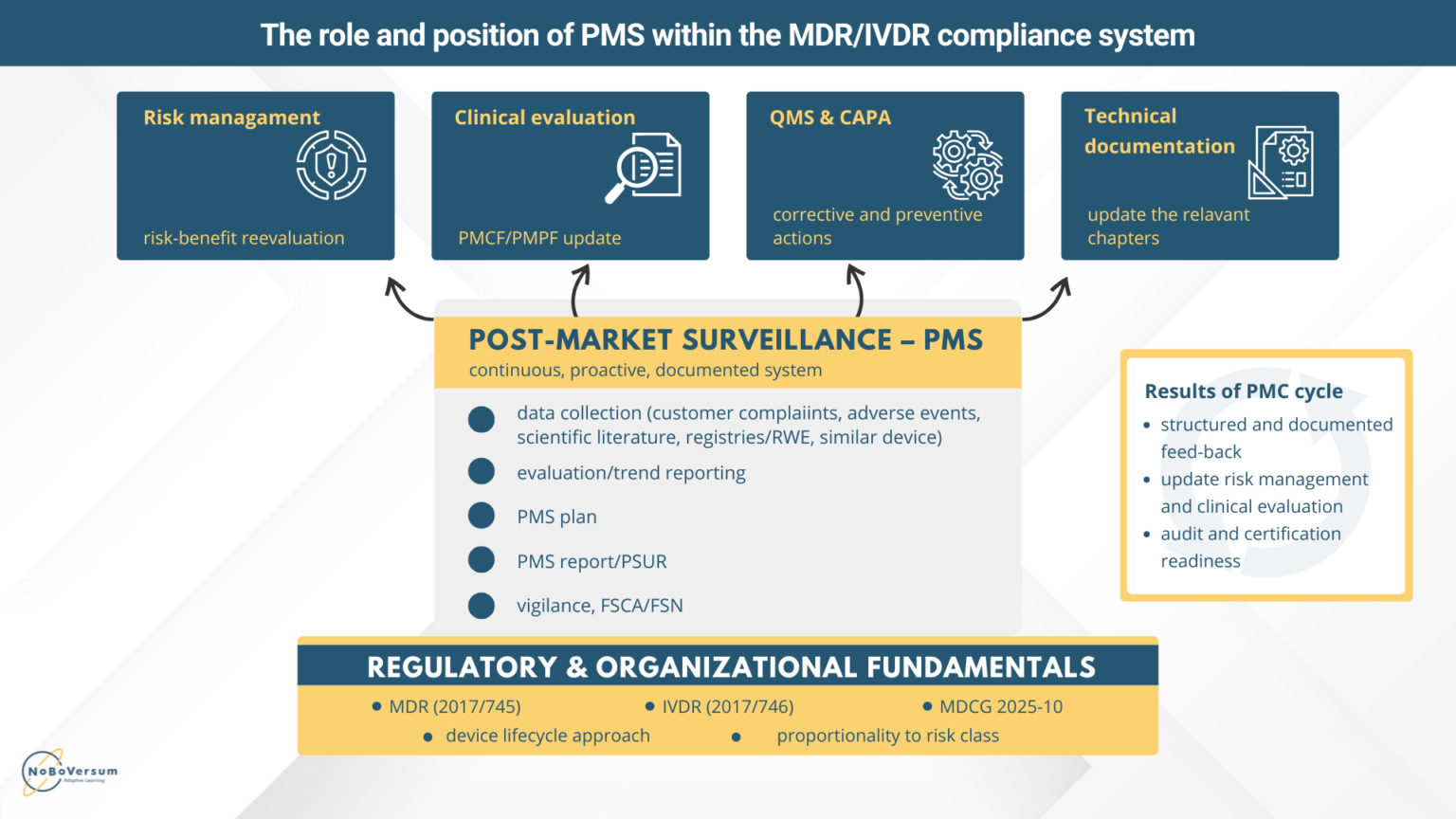
The new guidance makes it clear that PMS is not a separate administrative obligation, but a key element of the entire chain of conformity (QMS – risk control – clinical evaluation – technical documentation). The document is particularly important for manufacturers who want to avoid certification non-conformities, comments, and the time and cost losses associated with repairing defects in technical documentation.
On December 19, 2025, the MDCG 2025-10 guideline was published, which aims to provide manufacturers with clear, practical assistance in setting up and continuously operating a post-market surveillance (PMS) system in accordance with the requirements of the EU MDR (2017/745) and IVDR (2017/746).
The guidance provides detailed descriptions and practical examples of activities to be managed within a unified system, in accordance with PMS requirements as set out in various chapters and annexes of the MDR/IVDR. It also covers the relevant sections of technical documentation where information collected during PMS activities should be recorded and updated.
1. Designing and integrating the PMS into the QMS
The PMS is a continuous, proactive, and documented process that must be closely aligned with the manufacturer’s quality management system (QMS). The PMS is not merely a system used for data collection, but also forms the basis for risk control, clinical/performance evaluation, and corrective/preventive actions (CAPA). These activities must be carried out throughout the entire lifecycle of the product. The document emphasizes that PMS must also be established and maintained by manufacturers of custom-made devices.
2. PMS Plan
When developing a device, consideration must be given to the PMS plan, including the methods and parameters that the manufacturer will use to evaluate the safety and effectivenes of the product. The plan must be proportionate to the risk classification of the device.
The guidance on the content of the PMS plan (collection and evaluation method, procedure, parameters, risk control feedback) provides manufacturers with practical examples and explanations, with reference to the requirements set out in the relevant chapters of the MDR/IVDR.
3. PMS reports
Depending on the risk class specified in the MDR/IVDR, manufacturers must prepare PSURs or PMS reports and review them regularly. MDCG 2025-10 emphasizes that the documents must be proportionate, device-specific, and up-to-date. Although the guidance does not describe in detail how to prepare PMS reports or PSURs (Periodic Safety Update Reports) (which are regulated by other MDCG documents), it points out that they should be an integral part of the PMS cycle.
– PMS report: class I (MDR), class A-B (IVDR)
– PSUR: class IIa, IIb, III (MDR), class C-D (IVDR)
4. Main activities of the PMS system
Data collection and analysis: it is not sufficient to evaluate the safety and effectiveness of a device based solely on customer complaints and feedback; continuous, proactive data collection is necessary from at least the following sources:
- collection of adverse events (AEs) from distributors and importers, monitoring of scientific literature, systematic collection of registries and real-world evidence (RWE), monitoring of data available on similar devices;
- re-analysis of the risk-benefit ratio based on the collected data to determine whether the product needs to be modified or the IFU updated.
Trend monitoring: statistical methods should be used to evaluate the increase in the frequency of non-serious events to determine whether corrective and preventive action (CAPA) is necessary.
Updating risk control documentation: the results of PMS should be included in the risk control file and the relevant sections of the QMS.
Clinical evaluation and PMCF/PMPF: As part of PMS activities, the manufacturer must update the clinical evaluation based on PMCF/PMPF reports, taking into account the results of data collection and analysis.
Reporting obligations: vigilance reports, FSCA/FSN, and timely communication with authorities and notified bodies.
Summary
The MDCG 2025-10 guidance makes it clear that effective PMS is not an administrative burden, but a key device for ensuring patient safety, conformity, and long-term market presence in the MDR/IVDR environment.
Author: dr. Katalin Tauberné Jakab (Clinical Expert, NoBoVersum)